 NexIP官方博客
Many sellers assume that as long as they buy the right country's IP for Shopee Southeast Asia local stores, everything is fine. However, in reality, if the exit IP of a site only matches the country, it may still trigger cross-site risk control. The core of Shopee Southeast Asia local store proxy IP selection is to focus on four levels: ASN attributes, /24 subnet distribution, login state stability, and environmental consistency, rather than just looking at the country of origin.
Since 2026, industry observations show that Shopee's multi-site underlying account behavior and risk control systems are highly interconnected, and abnormalities on one site may affect other sites. The following criteria come from public seller feedback and technical troubleshooting experience summaries. Shopee has not released specific association rules and thresholds, and actual execution is subject to platform policies. Let's break down how to self-check layer by layer.
First Level: Is the Exit ASN Registered to a Local Residential ISP or a Data Center Hosting? How to Check Each Site
First, let's address a common question with facts: Is it mandatory to use local residential IPs for local stores? The answer is yes, it is a hard requirement—the exit IP must be a local native dedicated static residential IP (ISP attribute). Data center IPs and frequently changing dynamic IPs cannot be used for backend login. ASN (Autonomous System Number) is key to identifying attributes: the ASN of residential broadband providers is usually registered to local telecom, fiber, or home broadband services, while data center ASNs often include words like Hosting, Data Center.
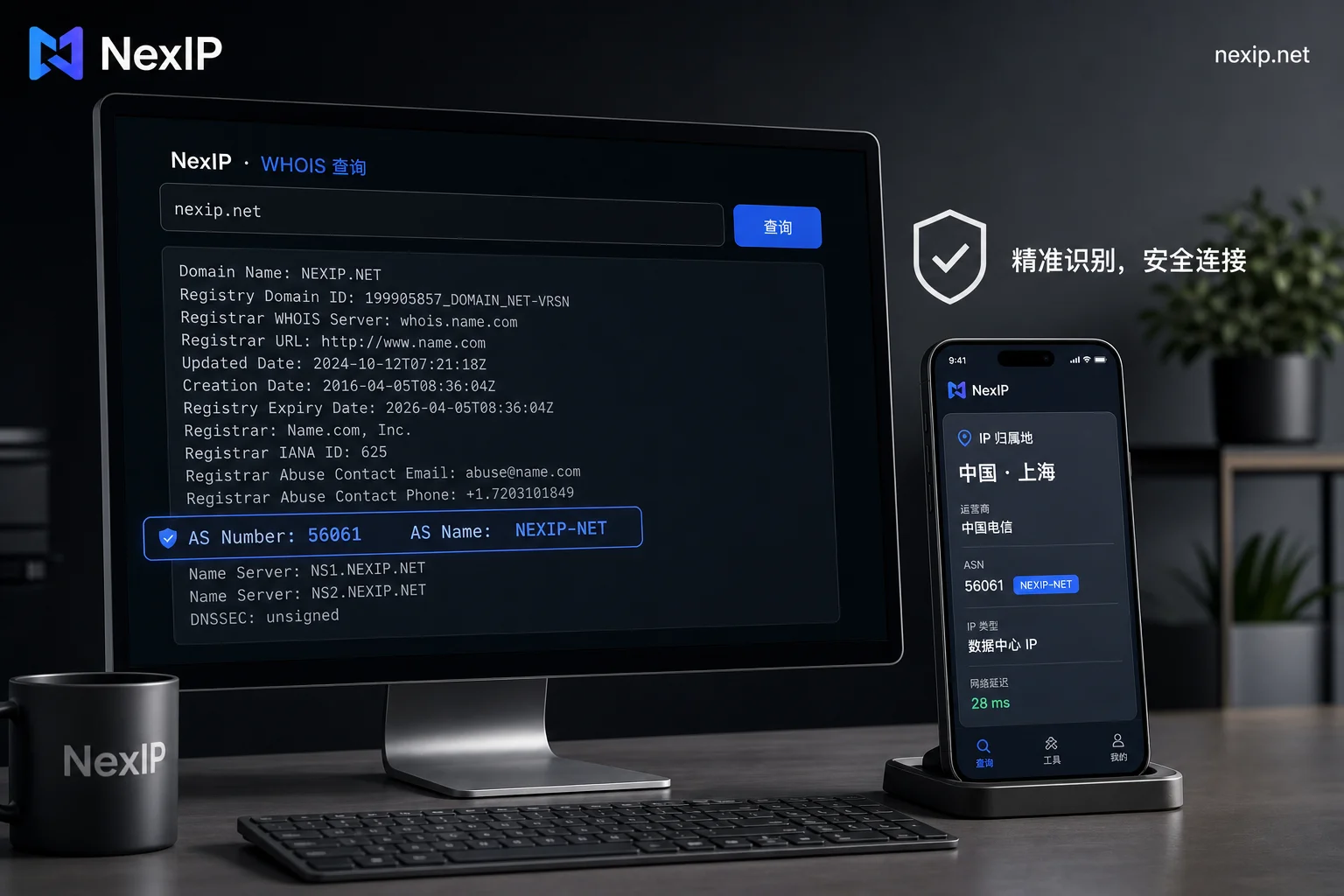
Steps to check each site: Before logging into each site's backend, open a whois query page in your browser and enter your exit IP to view the ASN registration entity; then use WebRTC and DNS leak detection tools to confirm that the request exit matches the proxy IP, avoiding real IP leaks. When checking ASN, look at the netname/org fields in the whois response—if they are local telecom or broadband operator names, it's fine; if they contain Hosting, Data Center, Cloud, VPS, etc., it's considered a data center segment. WebRTC and DNS checks should confirm that the returned public IP is exactly the same as the proxy exit IP, and the DNS exit country matches the proxy country. So, using local residential IPs is not optional; ISP attribute is a prerequisite.
Second Level: Should Shopee Malaysia and Thailand IPs Be Separate? The Associated Risk of the Same /24 Subnet
The answer to "Can multiple Shopee stores use the same IP?" is: Definitely not share the same IP. But even if countries are different, if the exits of the five sites fall within a contiguous /24 subnet of the same provider, there is still cross-site association risk. A /24 subnet refers to an address block where the first 24 bits are the same, e.g., 192.168.1.x. If the exits for Malaysia, Thailand, Philippines, Vietnam, and Indonesia are all in the same C segment, plus reused fingerprints or payment entities, the system can easily identify them as operated by the same entity.
Self-check table: Record the exit IPs of the five sites, compare whether the first 24 bits are the same, and verify whether the ASNs are consistent. If multiple sites fall in the same /24, it is recommended to at least ensure different C segments between different sites. Not only should Malaysia and Thailand sites have independent IPs, but their ASNs and C segments should also be different. For a more systematic approach to multi-store environment isolation, refer to proxy IP anti-association.
Third Level: Does the Exit Drift During Login? How to Continuously Sample and Verify
Network environment stability is one of the association criteria. Even if the IP is static, if the exit frequently changes after login—e.g., jumping from Kuala Lumpur to Bangkok, or switching to another city after disconnection and reconnection—it may be flagged as an abnormal environment. Verification method: After logging into the store backend, record the exit IP every 10 minutes for 2 hours to observe whether there is cross-city or cross-country drift; then test whether reconnecting returns to the same exit. A stable static residential IP should always anchor to the same city and ASN.
Fourth Level: Environmental Consistency—City of Origin, Time Zone Language, DNS Resolution, and Payment Entity Corroborate Each Other
In addition to the IP itself, environmental consistency is also important. The city of the IP's location should match the store registration address and shipping location; the browser time zone, language, and DNS resolution results should also match the IP's location. For example, if a Thailand site IP is in Bangkok, the browser language and time zone should be Thai and UTC+7, and the payment account entity should match the store registration entity. By aligning registration information, payment accounts, and browser fingerprints in the same chain, you can reduce the probability of misjudgment. Whether local stores and cross-border stores should be isolated falls into the same consistency chain: exit IP, browser fingerprint, login device, and payment entity must be completely separated, and you cannot relax just because the site countries are different. For similar platform exit environment requirements, refer to the configuration logic of Amazon store IP.
Five-Site Allocation Table: How to Apply Shopee Southeast Asia Local Store Proxy IP Selection Tips to Each Site
Combining the above four levels of criteria results in a directly executable set of Shopee Southeast Asia local store proxy IP selection tips: each site's backend binds an independent local static residential exit, fingerprint environment and payment entity are not shared; public product selection and competitor price collection are separated from backend login environment, using session sticky or rotating dynamic residential proxies.
| Site | Backend Login Exit | Fingerprint Environment | Payment Entity | Public Collection Exit |
|---|---|---|---|---|
| Malaysia | Independent static residential IP (ASN local ISP, C segment separated) | Independent fingerprint | Independent payment | Dynamic residential proxy (session sticky) |
| Thailand | Independent static residential IP (Bangkok, ISP attribute) | Independent fingerprint | Independent payment | Dynamic residential proxy (rotation) |
| Philippines | Independent static residential IP (Manila, ISP attribute) | Independent fingerprint | Independent payment | Dynamic residential proxy (rotation) |
| Vietnam | Independent static residential IP (Ho Chi Minh, ISP attribute) | Independent fingerprint | Independent payment | Dynamic residential proxy (session sticky) |
| Indonesia | Independent static residential IP (Jakarta, ISP attribute) | Independent fingerprint | Independent payment | Dynamic residential proxy (session sticky) |
Note: Backend login and payment environments must never share the same exit or fingerprint; public data collection, since it does not involve login state, is better suited for dynamic residential bandwidth to disperse traffic characteristics.
Using IPs by Phase: New Store Verification Period, Daily Backend Login Period, Product Selection Collection Period
According to the store lifecycle, exit type selection should vary. During the new store verification period (e.g., testing login, environment debugging), you can use short-term static residential IPs, which are low-cost and easy to change quickly; during the daily backend login period, you must use long-term fixed exits to ensure login state stability and pure ASN attributes; during the product selection collection period (high-frequency access to public pages), you should use dynamic residential proxies to avoid a large number of requests concentrating on the same backend exit, reducing the risk of being identified as bot behavior.
Mapping to NexIP: How Static Long-Term, Static Short-Term, and Dynamic Residential Bandwidth Divide Work
When implementing the allocation table, NexIP's public region selection, city/ASN targeting, session sticky, HTTP/SOCKS5, and API integration capabilities can correspond to three types of work: long-term backend login chooses static long-term residential IPs, with city or ASN targeting per site; new store verification and short-term testing use static short-term; public product selection and competitor price collection use dynamic residential bandwidth. For example, the Malaysia site needs a residential ISP in Kuala Lumpur, and the Thailand site needs a residential ISP in Bangkok. City/ASN targeting can avoid different sites falling into contiguous segments of the same provider. API integration facilitates batch configuration in fingerprint browsers, see fingerprint browser proxy configuration. Additionally, understanding the difference between residential IP and data center IP is also fundamental to avoiding choosing the wrong attribute.
Pre-Launch Self-Check Checklist and Common Misconceptions
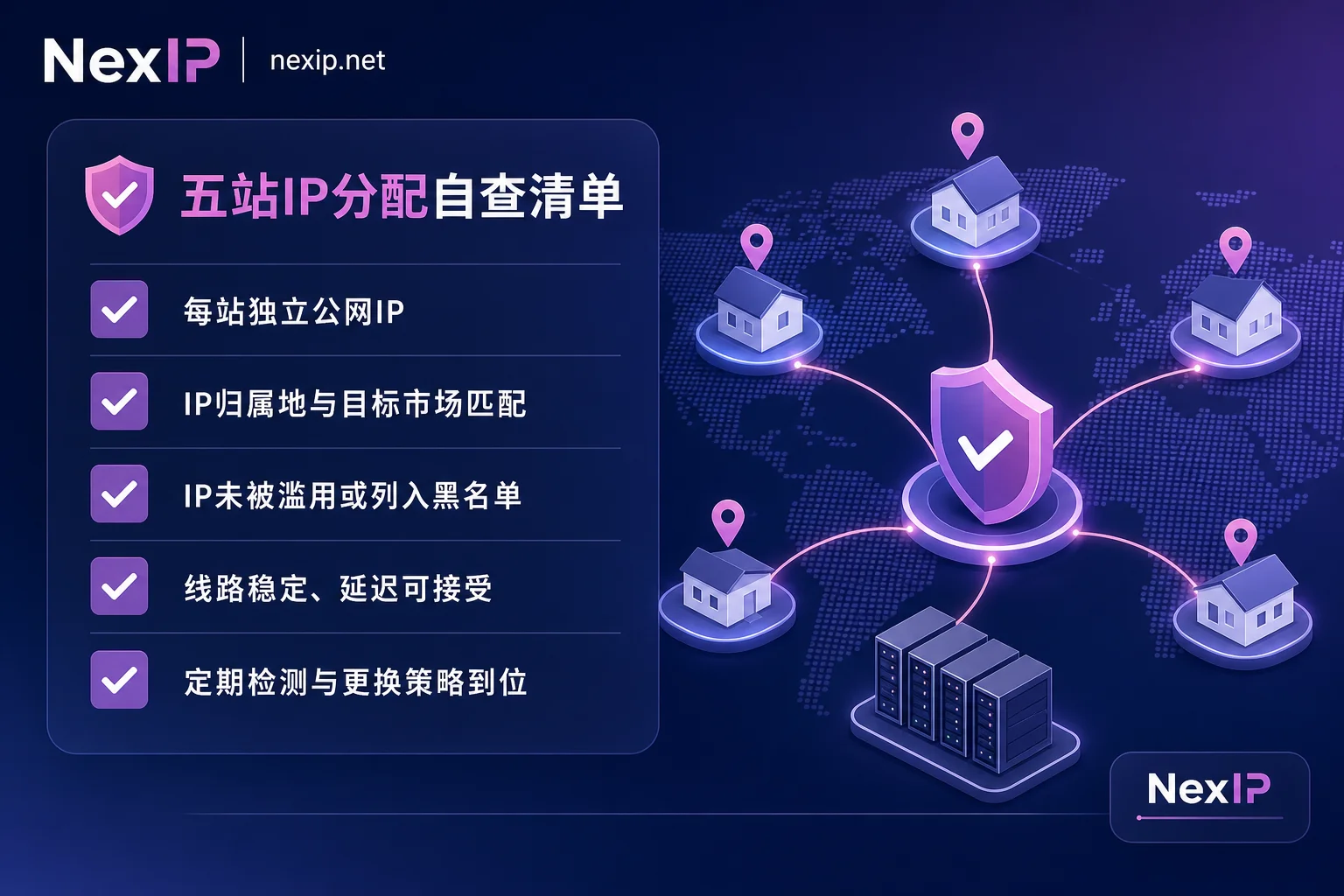
Finally, compress the Shopee Southeast Asia local store proxy IP selection tips into a checkable checklist to avoid common pitfalls like "buying the right country is enough":
- [ ] The ASNs of the five sites' exit IPs are all local residential ISPs, without Hosting in the name;
- [ ] The five sites' exit IPs are not in the same /24 subnet, and ASNs are preferably different;
- [ ] Each site's login state has been sampled continuously for 2 hours without cross-city drift;
- [ ] Each site's browser time zone, language, and DNS resolution match the IP's location;
- [ ] Payment accounts match the store registration entity, and each site is different.
There are three common misconceptions: first, thinking "buying the right country is enough," ignoring ASN attributes; second, thinking "contiguous subnets of the same provider are fine," but with cross-site data exchange, the risk is high; third, thinking "residential IP = never associated," but association also depends on payment accounts, product overlap, browser fingerprints, and operational behavior.
FAQ
Can multiple Shopee stores use the same IP?
Not recommended. Using the same IP to log into multiple stores simultaneously will be directly identified as the same entity operating, easily triggering association bans. Even for different sites, the same IP should not be shared, and it's best to have different C segments as well.
Must local stores use local residential IPs?
Yes. You must use a native static residential IP that matches the target country and city. Data center IPs or dynamic IPs are not allowed. IPs with local ISP attributes are a hard requirement; otherwise, the environment will be flagged as abnormal.
Should Shopee Malaysia and Thailand IPs be separate?
Yes, they should be separate. Not only should IPs be independent, but ASNs and subnet segments should also be as different as possible. If the two sites fall into a contiguous subnet of the same provider, there is still a cross-site association risk.
How to check the cause if a Shopee store is flagged as associated?
First, check if the IP is duplicated and whether the ASN is a residential ISP, then compare subnet segments. Next, check if browser fingerprints, time zone language, and payment entities are consistent. Use whois and fingerprint detection tools to eliminate possibilities one by one, focusing on these four levels of criteria.
Should the network environments of local stores and cross-border stores be isolated?
Yes, they must be isolated. Local and cross-border stores should use different exit IPs, fingerprint browsers, and login devices, and cannot be mixed. Also, payment entities should be separated to reduce the probability of association.


Comments(0)