 NexIP官方博客
Residential proxies are being used more and more these days, especially for AI data scraping and multi-account management. At the same time, website defenses are upgrading—simply rotating IPs is no longer enough. Many tasks require the same IP to hold through the entire process, such as logging in and then browsing pages, filling forms, placing orders, or warming up accounts. This is where sticky sessions become critical.
In simple terms, a sticky session means the proxy keeps the same exit IP for a set period. This can be configured from a few minutes to tens of minutes or even longer. It differs from pure rotation: rotation is suited for high-volume stateless scraping, switching IPs per request to avoid rate limits; sticky is for stateful operations, preventing session breaks due to IP changes, cookie invalidation, or triggering risk controls.
The problem is that not all "residential proxy sticky" offerings deliver the same performance. Recent baseline data from continuous probing, covering a large number of probes over about thirty days, reveals striking differences: sticky session survival rates range from a bit over 70% to over 90%, with some reaching about 98% and others only around 80%. More troubling is the rate of unexpected mid-session rotation, ranging from 1% to over 6%. You may set a ten-minute sticky, but halfway through, the IP switches on its own, breaking the login flow. Many providers advertise "99% uptime" for overall availability, but this masks such mid-session failures. Only continuous probing reveals the real picture.
Why is this issue more prominent now? As AI scraping scales up, massive traffic flows to websites through residential and mobile networks. Some of these IPs come from user-informed sharing, others from SDK integrations, hidden clauses in free VPNs, or even IoT devices infected with malware. Websites have increased behavioral detection, fingerprinting, and proof-of-work (PoW) verification, affecting even normal users. Low-quality pools are more easily flagged and associated, so even long sticky sessions cannot hold. Conversely, if your pool is unstable with frequent mid-session rotations, success rates drop, and retry costs increase.
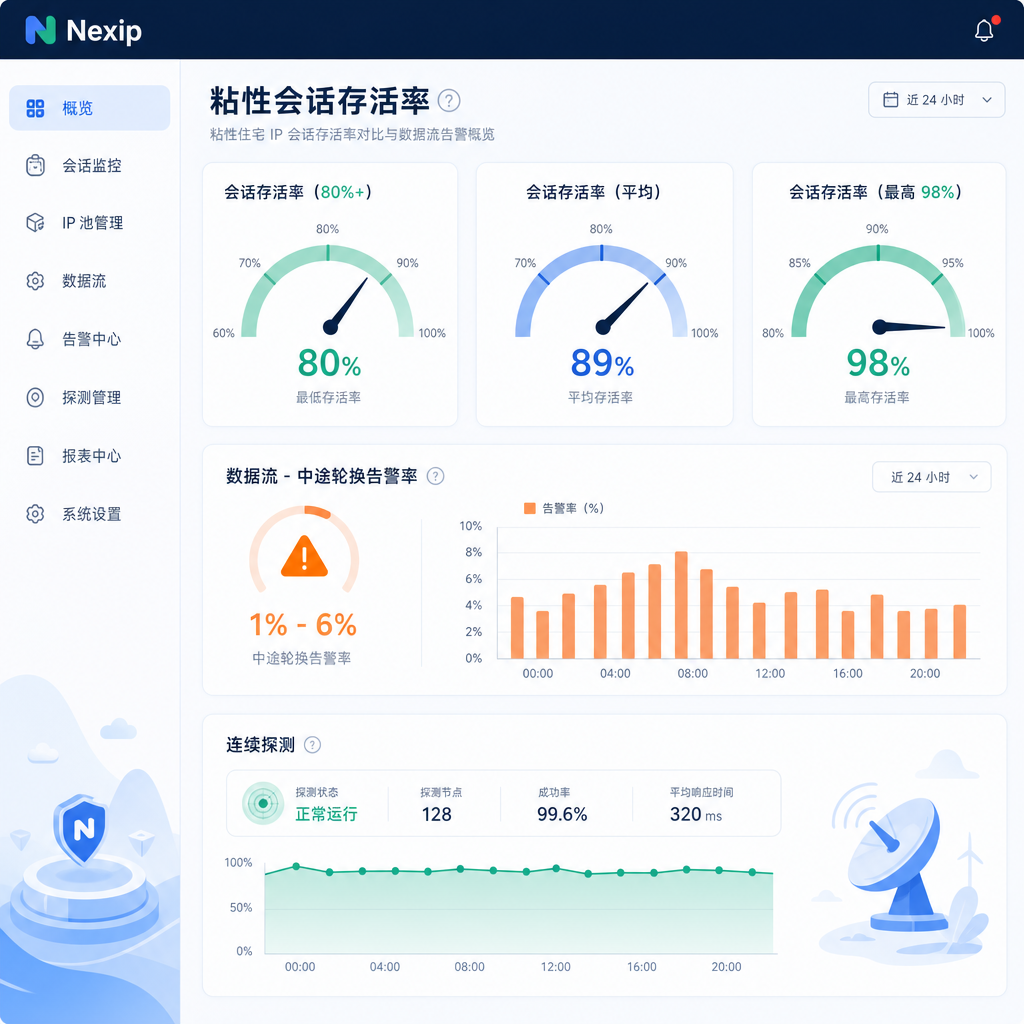
How to choose and configure in practice? First, distinguish your scenario. For pure stateless scraping (price monitoring, bulk SEO ranking), prioritize rotating residential proxies, focusing on pool size and success rates. For tasks requiring login, multi-step operations, or account binding, you must look at sticky survival rates. ISP proxies tend to be more stable for long sessions; pure dynamic residential depends on the provider's session control capabilities. Match your workflow: speed priority uses datacenter proxies, stable sessions use ISP or high-quality sticky residential, and global scale uses rotating residential.
Don't rely only on marketing pages for testing. Write a simple probe: request an endpoint that returns the IP, fix the session ID or port, run continuously for 10–30 minutes, and record whether the IP changes or the response breaks. Test against several target sites, especially those with login walls. If the survival rate is below 90%, don't use that pool for login tasks. Also, monitor mid-session rotation frequency; anything above 2–3% is a red flag. Check the p95 latency, as a fast median with poor tail latency can stall time-sensitive flows.
Key configuration points. First, set TTL longer than your longest flow. If login, verification, and operations take two minutes, don't set a 60-second sticky—forced IP rotation at expiry is self-destructive. Many providers support customization; start with 10 minutes as a baseline, and extend to 30 minutes for complex flows. Second, keep session management clean: one session ID per task, don't share among multiple accounts, and avoid manual switching mid-session. Third, pair fingerprinting with proxy configuration. Having a stable IP is useless if browser fingerprint, timezone, language, or canvas still jumps around. Use an anti-detection browser to bind a fixed fingerprint and then attach the sticky IP. Fourth, monitor in real time. Add IP change detection in your scripts—if a mid-session switch occurs, retry or switch to a backup session, don't push through. Fifth, prioritize ethics and compliance. Choose pools that clearly state their source and support opt-out; avoid those that secretly pull devices via SDKs or free tools. Low-quality pools not only risk getting blocked but may also bring legal risks—devices become unwitting participation in proxy networks.
There are many common mistakes. Some think "residential is enough," only to buy a pool with short sticky or frequent mid-session rotations, causing all logins to fail. Some compare only price, choosing cheaper bandwidth with high failure rates, which actually costs more. Some set sticky time too short or mix sticky with rotation, losing state mid-task. Others ignore pool refresh and degradation—using the same set of IPs for too long leads to flagging and a sharp drop in survival rate. Solutions include periodically changing pools, monitoring success rate trends, and, if necessary, mixing ISP for core sessions and rotating residential for peripheral tasks.
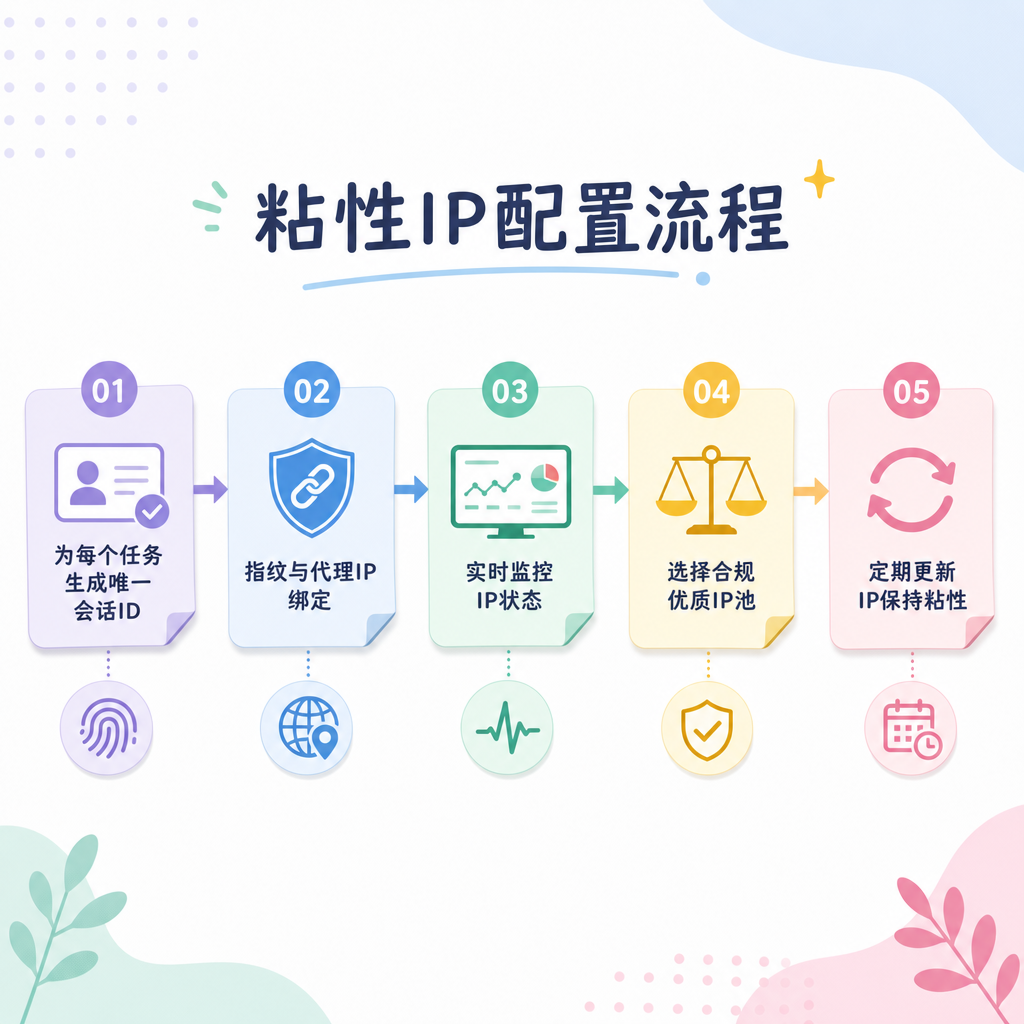
In real-world cases, multi-account farming or e-commerce monitoring often hits pitfalls. After logging into an account, you need to maintain a session for content publishing or price verification; an IP change mid-session causes account drop or triggers two-factor authentication. Using high-survival sticky sessions significantly improves success rates. AI agent multi-step decision-making also relies on IP consistency. Here, choosing a service that supports stable sticky sessions is key. Nexip offers flexible session control for dynamic residential IPs, matching such needs well, helping you achieve solid survival rates and mid-session stability without daily headaches over IP switching.
Additional details: don't over-provision bandwidth; sticky sessions concentrate traffic, so watch for rate limits. Ensure geographic accuracy—for city-level requests, confirm the exit destination. Use exponential backoff for retries on failure; don't immediately switch IPs, which increases flagging risk. Periodically run small-scale verification tests; don't wait until a large task to discover the pool is failing.
In summary, sticky sessions are no longer just "nice to have"—survival rate and mid-session stability must be measured. Baseline data is already available, showing large differences. When selecting, run more probes and benchmark against your workflow. Properly configured, login and multi-step tasks run smoothly; poorly configured, even a large pool is useless. Focus on these practical points, and both efficiency and stability will improve. Options like Nexip, which emphasize session quality, are worth considering in your test pool, especially for scenarios requiring long-term stable exits.




Comments(0)